


Think your signed contract guarantees the sale?
Not if there’s an appraisal gap.
An appraisal gap is the shortfall between the contract price and the value a licensed appraiser assigns.
It matters because lenders base loans on the appraised value, not the offer.
When a gap appears, buyers may need extra cash, closings can stall, and negotiation power shifts toward whoever can cover the difference.
This post shows why gaps happen, how they reshape closings, and practical moves buyers, sellers, and agents can use to keep deals on track.
Understanding Appraisal Gaps and Their Direct Impact on Closing Outcomes

An appraisal gap happens when the price you agreed to pay exceeds the value a licensed appraiser assigns to the property. Lenders don’t finance based on what you offered. They finance based on what the appraiser says the home is worth. That difference creates an immediate funding problem. If the appraisal comes in at $380,000 but your contract says $400,000, your lender will only approve a loan calculated from $380,000. The $20,000 gap has to come from somewhere, or the deal stalls.
About 8% of home appraisals land below the contract price. That number climbs in competitive markets where buyers bid aggressively and inventory is tight. Los Angeles, Austin, and Chicago see appraisal gaps more often than cooler markets because offers routinely run ahead of the comparables appraisers use. When your lender orders the appraisal, the appraiser pulls recent closed sales to anchor the value. If those sales closed weeks or months ago and prices have since jumped, the appraisal may not keep pace with your offer.
Low appraisals don’t just create paperwork headaches. They threaten conditional approvals and closing timelines. Here’s what typically follows when an appraisal falls short:
- Buyer must find additional cash to cover the gap or the lender won’t release full loan proceeds.
- Closing may be delayed while buyer and seller renegotiate price or terms.
- Buyer may invoke an appraisal contingency to cancel the contract and recover earnest money.
- Seller may accept a backup offer or relist if the original buyer can’t close.
Key Causes of Appraisal Gaps in Residential Transactions

Appraisal gaps most often arise when buyer emotion and market competition push offers beyond what recent sales data can justify. In bidding wars, buyers stretch to win. But appraisers are constrained by comparable sales that may be weeks or months old. If prices are rising fast, the comps lag, and the appraised value lands below the accepted offer.
Custom upgrades and unique property features also create gaps. A home with high-end finishes or unusual layout may command a premium from buyers, but if nearby sales lack similar features, the appraiser has limited data to support the higher value. Limited inventory compounds the problem. When few homes have sold recently in a neighborhood, the appraiser must pull comps from farther away or use older transactions. Both of which can undervalue a property in a hot market.
| Cause | Why It Leads to a Gap |
|---|---|
| Bidding wars and emotional overbidding | Offers exceed documented market value when buyers compete without regard to comps |
| Rapid price increases in hot markets | Appraisers rely on sales closed 30 to 90 days ago, which may not reflect current upward momentum |
| Custom or high-end upgrades | Unique features lack sufficient comparable sales, making it hard for appraiser to justify premium |
| Limited recent sales data | Thin inventory forces appraiser to use older or distant comps that may undervalue the subject property |
How Appraisal Gaps Shift Negotiation Power Between Buyers and Sellers

A low appraisal immediately reshuffles the deck. In a hot market with multiple backup offers, sellers can hold firm on price and force buyers to cover the gap or walk. In a slower market where inventory is rising and days on market are climbing, sellers face pressure to reduce the price or risk losing the deal and relisting at a lower number anyway.
Buyers gain negotiating room when they can credibly threaten to cancel using an appraisal contingency. If the contract lets the buyer exit without penalty after a low appraisal, the seller must choose between a price cut and starting over with a new buyer who may also face the same appraisal ceiling. Conversely, if the buyer waived the appraisal contingency or signed an appraisal-gap clause, the seller can refuse to budge. They know the buyer is contractually committed.
The most common middle ground is a split. When the gap is $10,000, the seller may agree to reduce the price by $5,000 and the buyer covers the remaining $5,000 in cash. Other paths include the seller offering closing cost credits, extending the closing date to give the buyer time to secure additional funds, or the buyer reducing the down payment percentage to free up cash for the gap. Here are the five most frequent negotiation responses:
- Seller reduces purchase price to match appraised value.
- Buyer pays the full gap in cash and proceeds at original price.
- Both parties split the difference, sharing the cost of the shortfall.
- Seller offers concessions such as closing cost credits or repair allowances to offset buyer’s extra cash requirement.
- Buyer cancels the contract under appraisal contingency and retains earnest money.
Financial Mechanics: How a Low Appraisal Changes Loan Amounts and Cash to Close
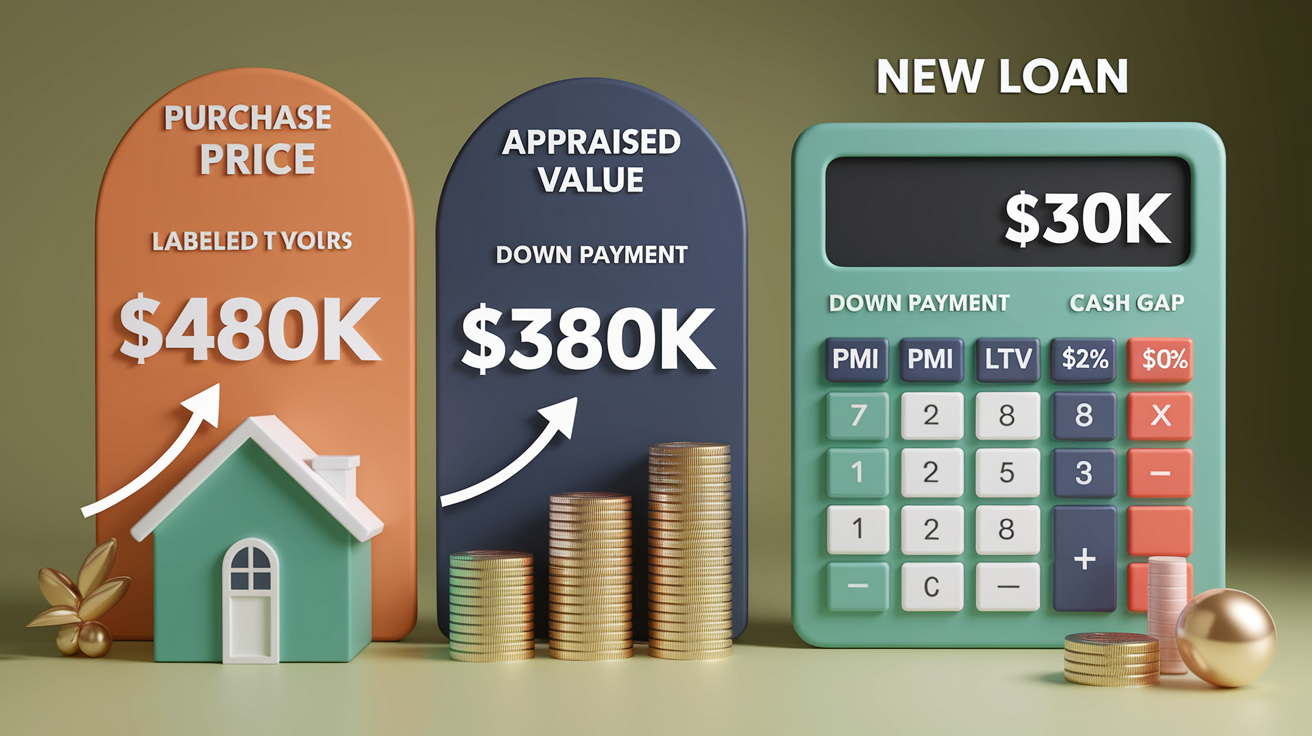
Lenders calculate your loan using the lower of the purchase price or the appraised value. If you offered $400,000 and the appraisal came in at $380,000, the lender will approve a mortgage based on $380,000. If you planned to put down 20 percent, that’s $76,000 on the appraised value, not the $80,000 you originally budgeted. The $20,000 appraisal gap must be covered separately, on top of your down payment.
One common workaround is to reduce your down payment percentage and redirect that cash to cover the gap. If you drop from 20 percent down to 15 percent on the $380,000 appraised value, you free up roughly $19,000 to put toward the gap. The tradeoff is a larger loan and, often, private mortgage insurance until you reach 20 percent equity. Different loan programs carry different loan to value limits. Conventional loans typically allow 80 to 97 percent LTV depending on the product, FHA loans go as high as 96.5 percent, VA loans can reach 100 percent for eligible borrowers, and jumbo mortgages often cap at 80 to 90 percent. Here’s what changes when the appraisal is low:
- Your maximum loan amount drops to a percentage of the appraised value, not the contract price.
- Your required cash to close increases by the full amount of the appraisal gap if you maintain your original down payment percentage.
- You may choose to lower your down payment percentage to reallocate cash toward the gap, which increases your monthly payment and may trigger PMI.
- Underwriting recalculates debt to income ratios and reserves based on the new loan amount and any gap coverage cash you provide.
Buyer and Seller Options When an Appraisal Gap Threatens the Closing
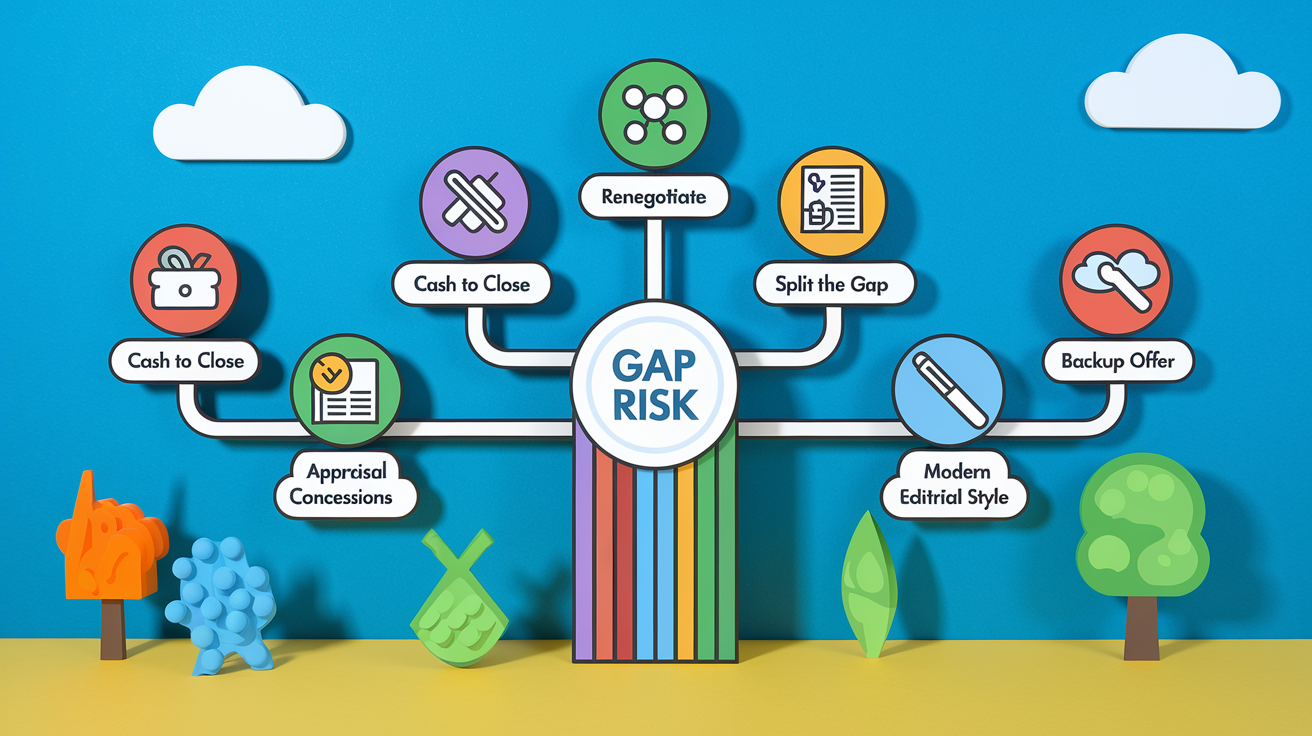
Buyers facing a gap have several funding routes. Cash reserves are the simplest. If you have the money saved, you write a larger check at closing. Gift funds from family can cover all or part of the shortfall, though lenders require a gift letter and documentation. Selling investments, tapping a 401(k) under first time homebuyer provisions, or taking a home equity line of credit on another property are also common. Though each carries tax or interest implications worth reviewing with an advisor.
If covering the gap in cash isn’t feasible or attractive, renegotiation is the next step. Ask the seller to reduce the price to the appraised value, especially if days on market are climbing or competing offers have dried up. If the seller won’t move the full distance, propose a split or request concessions such as paying part of your closing costs or offering a credit for repairs. Moving quickly matters. Some contracts include kick out clauses that let sellers accept backup offers if the primary buyer can’t perform within a set window.
When neither cash coverage nor renegotiation works, the appraisal contingency provides an exit. If your contract includes this protection, you can cancel without forfeiting your earnest money. Sellers, meanwhile, can pivot to backup offers, relist, or wait for the next buyer and hope for a higher appraisal with fresh comps. Here are the six most common decision paths:
- Buyer covers the full gap using savings, gifts, or liquidated assets.
- Buyer reduces planned down payment percentage to free up cash for the gap.
- Seller lowers purchase price to appraised value.
- Buyer and seller split the gap, adjusting price and buyer cash contribution equally.
- Seller offers concessions or closing cost credits to offset buyer’s increased cash requirement.
- Buyer invokes appraisal contingency to cancel contract and recover earnest money.
Disputing or Re-Evaluating a Low Appraisal: ROVs, Second Appraisals, and Appraisal Rebuttals
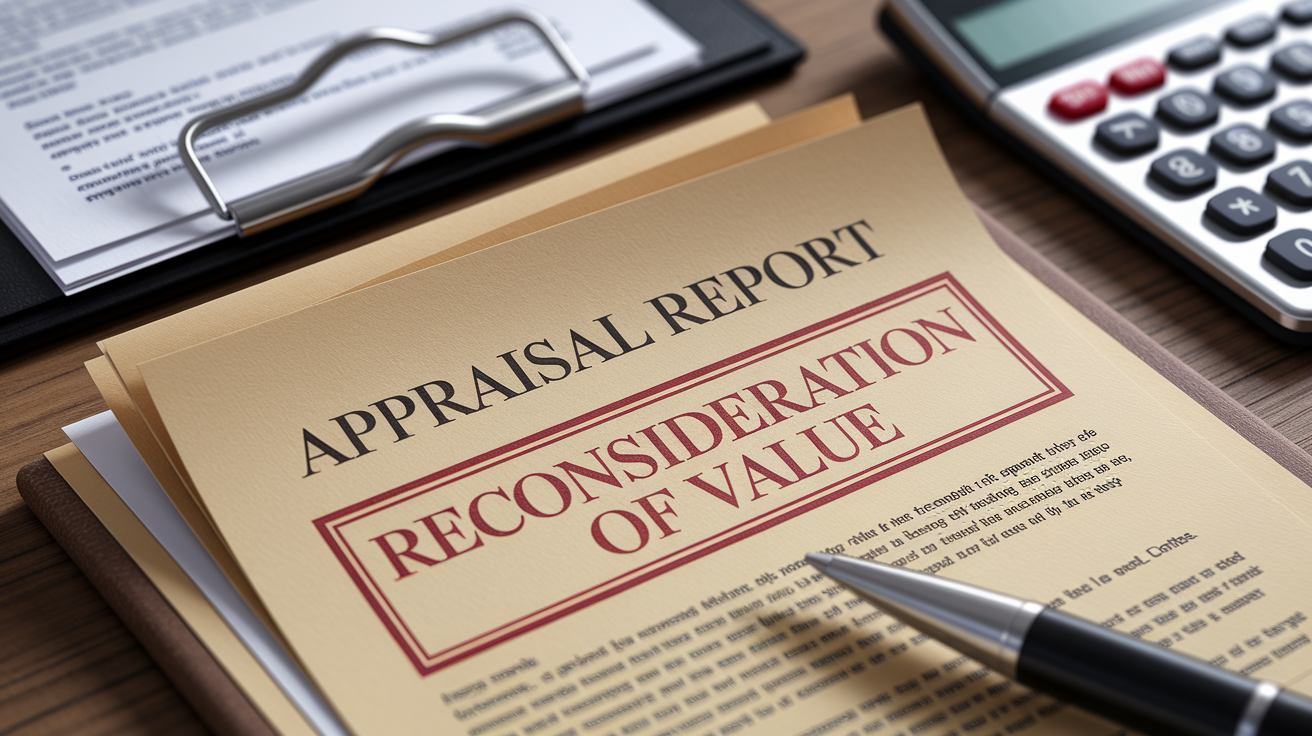
If you believe the appraisal is wrong, you can request a reconsideration of value. An ROV is a formal written request submitted through your lender, usually accompanied by stronger comparable sales or evidence that the appraiser made a factual error or used inappropriate comps. Success isn’t guaranteed. The appraiser and lender review the new information, but they’re under no obligation to change the valuation unless the evidence clearly shows a mistake.
Common grounds for dispute include the appraiser using sales from a different neighborhood or price tier, missing recent upgrades such as a new roof or renovated kitchen, making calculation errors on square footage, or relying on a drive by inspection when interior condition matters. Providing recent closed sales that better match your property’s features and location can strengthen the case. Agents often help compile this data. In some cases lenders will order a second appraisal from a different appraiser, though the buyer typically pays the additional fee and the lender decides which value to use.
Valid grounds for an appraisal dispute typically include:
- Appraiser used comps from a different market area or price range.
- Appraiser overlooked or undervalued recent upgrades, features, or improvements.
- Factual errors in square footage, bed/bath count, lot size, or property condition.
- Drive by or exterior only inspection when interior features justify higher value.
Preventing Appraisal Gaps Before They Happen
The best defense against appraisal gaps is realistic pricing tied to recent comparable sales. Before making an offer, ask your agent for a detailed comparative market analysis showing what similar homes have sold for in the past 30 to 90 days. If your offer is significantly above those comps, you’re increasing gap risk. In competitive markets, consider including an appraisal gap clause in your initial offer. A clause might read: “Buyer agrees to pay up to $20,000 above appraised value, but not exceeding the purchase price.” This signals to the seller that you’re prepared to close even if the appraisal is low, which can make your offer stand out without committing you to unlimited exposure.
Cash buffers and contingency planning also reduce risk. Budget extra funds beyond your down payment and closing costs so you have room to cover a moderate gap without scrambling. If you’re a seller, price the home at or slightly below recent comps to reduce the chance a buyer’s offer will outrun the appraisal. Pre listing appraisals are an option, though they’re not binding on the buyer’s lender. Limiting overbidding and including appraisal contingencies in your contract gives you negotiation leverage and an exit if the value doesn’t support the price.
| Strategy | Best For | How It Reduces Gap Risk |
|---|---|---|
| Offer tied to recent comps | Buyers in any market | Keeps offer within range appraisers are likely to support with existing sales data |
| Appraisal gap clause with dollar cap | Competitive buyer offers | Signals willingness to cover limited gap, making offer stronger without unlimited exposure |
| Pre listing appraisal or agent CMA | Sellers pricing a home | Anchors list price to supportable value, reducing chance buyer offers will exceed appraisal ceiling |
| Cash reserve buffer beyond down payment | Buyers planning financed purchase | Provides funds to cover gap without renegotiation, keeping deal on track and closing on time |
Real World Appraisal Gap Scenarios and Their Closing Outcomes

A buyer offers $325,000 on a home listed at $300,000, planning a 5 percent down payment of $16,250. The appraisal comes in at $305,000. The lender will only finance based on $305,000, so the buyer’s 5 percent down payment is now $15,250. The $20,000 gap between offer and appraisal must be covered separately. Total cash needed at closing jumps to roughly $35,250. The down payment on the appraised value plus the full gap. The buyer doesn’t have an extra $20,000 in reserves, so they ask the seller to reduce the price. The seller agrees to drop to $315,000, splitting the $20,000 gap in half. The buyer now covers $10,000 out of pocket, and the new loan is calculated on the $305,000 appraisal. Closing proceeds two weeks late while the contract is amended.
Another buyer offers $400,000 with a planned 20 percent down payment of $80,000. The appraisal returns at $380,000. The buyer has an appraisal gap clause capping coverage at $20,000. Instead of paying $20,000 on top of the down payment, the buyer shifts $20,000 from the planned down payment to cover the gap. The new down payment is $60,000, which is 15 percent of the $400,000 purchase price, or roughly 15.8 percent of the $380,000 appraised value. The lender approves the loan, but the buyer now carries private mortgage insurance because equity is below 20 percent. Closing happens on schedule, but monthly payments are higher until the loan balance drops enough to cancel PMI.
A seller receives two offers. $390,000 with an appraisal contingency, and $395,000 with the contingency waived. The seller accepts the higher offer. The appraisal comes in at $380,000, creating a $15,000 gap. The buyer has no contractual exit and no extra cash. The buyer asks the seller to reduce the price. The seller refuses, pointing to the waived contingency, and offers to consider a two week extension for the buyer to secure gap funds. The buyer can’t find the money and forfeits the earnest deposit when they cancel. The seller then accepts the original $390,000 offer, which had remained a backup. The second appraisal, ordered by the new buyer’s lender, returns at $382,000, and that deal closes with a smaller $8,000 gap the buyer covers in cash.
Here are three common scenario outcomes:
- Buyer and seller split a moderate gap, amend the contract price, and close with a short delay while paperwork is revised and lender reapproves the adjusted loan amount.
- Buyer reduces down payment percentage to reallocate cash toward the gap, accepts a larger loan and PMI, and closes on time without price renegotiation.
- Buyer can’t cover the gap and cancels under appraisal contingency, or forfeits earnest money if contingency was waived. Seller moves to backup offer or relists, often at a price closer to the appraisal.
Final Words
We ran the playbook: what an appraisal gap is, why low appraisals cause funding shortfalls, how they shift negotiating power, the financing math, dispute options, prevention steps, and real scenarios that show outcomes.
Use the checklist—confirm comps, keep cash buffers, add appraisal-gap clauses, and be ready to split the difference. Those moves cut closing risk and save time. Keep this framework in mind when weighing offers, especially how appraisal gaps affect home sale closings and negotiation. You’ll be better prepared.
FAQ
Q: Is an appraisal gap coverage bad for a buyer?
A: Appraisal gap coverage is not necessarily bad for a buyer; it keeps offers competitive and avoids deal collapse, but it increases cash needed at closing and raises the risk of overpaying if value stays lower.
Q: How do you negotiate an appraisal gap?
A: To negotiate an appraisal gap, lead with stronger comps, ask the seller to reduce price, split the difference, request closing-cost credits, or agree to limited buyer cash coverage with a short deadline to close.
Q: What is the 3 day appraisal rule?
A: The 3 day appraisal rule typically means a contract or lender timeline giving parties three business days to accept, dispute, or cure a low appraisal before moving to remedies like price change or contract cancellation.
Q: What does $5000 appraisal gap mean?
A: A $5,000 appraisal gap means the agreed price is $5,000 above the appraised value, so the buyer must cover that $5,000 in cash or the seller must lower price or provide equivalent credits.