

Surprised that every U.S. state posted home price gains in Q1 2025?
It happened: year-over-year growth ran from 1.0% to 8.4%, with Connecticut and Rhode Island topping the list at 8.4% and New Jersey close behind at 7.8%.
But the headline masks the real pattern — the fastest gains cluster near expensive metro hubs where tight for-sale inventory, steady job growth, and post-pandemic remote-work moves pushed buyers outward.
This post explains which states led, why, and what buyers, sellers, and investors should watch next.
Top States Showing the Fastest Home Price Growth Right Now

Every U.S. state plus D.C. posted positive year-over-year home price appreciation in Q1 2025. Gains ranged from 1.0% to 8.4%. Connecticut and Rhode Island tied for the top spot at 8.4% each, with New Jersey right behind at 7.8%. Those three led a group of 26 states that beat the national pace of 4.7% YoY. Louisiana came in last at 1.0%, but even there prices moved forward.
What stands out: no state lost value year-over-year. That’s a clean sweep, though growth slowed from Q4 2024’s national 5.5% YoY pace. The 39 states that saw appreciation decelerate quarter-to-quarter are reacting to rising inventory and stubborn mortgage rates. But the baseline is still upward, just at a more cautious clip.
Top 5 States by Year-Over-Year Price Increase (Q1 2025):
- Connecticut, 8.4%
- Rhode Island, 8.4%
- New Jersey, 7.8%
- [Next-highest state from dataset, typically Massachusetts or similar Northeast corridor state]
- [Next-highest state from dataset]
Why These States Are Leading in Home Price Appreciation

The fastest-appreciating states share a tight set of drivers: strong labor markets, steady in-migration, and housing supply that can’t keep up. Connecticut, Rhode Island, and New Jersey all sit close to major Northeast employment hubs. They offer relative affordability compared to core urban markets while pulling buyers who still want access to New York City or Boston. Job growth in tech, healthcare, and finance has anchored demand. Remote-work flexibility let buyers push farther out without sacrificing income.
Remote work turbocharged that migration pattern. Households that could work from anywhere started chasing lower cost per square foot, better school districts, and more space. New Jersey became a landing zone for New York City buyers who could tolerate a longer train ride or no commute at all. Rhode Island and Connecticut offered coastal quality of life at a discount to Boston-area pricing. That arbitrage drove bidding wars in inventory-starved towns.
New construction hasn’t caught up. Permitting backlogs, labor shortages, and zoning restrictions in many Northeast municipalities kept new-home starts well below demand. When existing inventory is tight and builders can’t add supply fast enough, prices get bid up. Especially in states where demand is both local and spillover from more expensive neighbors.
Common structural drivers shared by top-appreciating states:
- Proximity to expensive metro hubs with strong employment and wage growth
- Migration inflows from higher-cost coastal markets seeking affordability or space
- Low for-sale inventory and slow permit approval processes limiting new supply
- Mortgage-rate sensitivity amplifying buyer urgency when rates plateau or dip slightly
Comparing Year-Over-Year Home Price Growth by State

Year-over-year comparisons smooth out seasonal noise and give a clearer read on sustained momentum. In Q1 2025, the national YoY gain of 4.7% sets the benchmark. Twenty-six states topped that mark. Just under half of all states are outpacing the country as a whole. The spread from 1.0% to 8.4% shows how local and regional factors carve deep differences into what looks like a single national market. Job markets, migration flows, inventory levels, they all matter.
Why YoY instead of month-over-month or quarter-to-quarter? Month-to-month moves can swing on listing patterns, weather, or rate headlines. YoY comparisons anchor to the same seasonal window a year earlier, so you’re comparing apples to apples. That’s why analysts lean on YoY for trend calls and use quarterly or monthly data as early-warning signals.
| State | YoY Change (%) | Above/Below National Average |
|---|---|---|
| Connecticut | 8.4 | Above |
| Rhode Island | 8.4 | Above |
| New Jersey | 7.8 | Above |
| [Third-lowest state] | [Percent from dataset] | Below |
| [Second-lowest state] | [Percent from dataset] | Below |
| Louisiana | 1.0 | Below |
Five-Year Home Price Appreciation Patterns by State

Between Q1 2020 and Q1 2025, U.S. home prices climbed 54.9% nationally. That five-year window captures the pandemic demand surge, the 2021–2022 rate spike, and the 2023–2024 cooling. At the metro level, five-year appreciation ranged from 16.7% in Lake Charles, LA to 90.1% in Hinesville, GA. Those extremes show how local economies, military-base expansions, hurricane recovery cycles, and industrial shifts can either turbocharge or stall long-term growth.
States that led the five-year national pack often combined structural tailwinds with cyclical ones. Population growth, new employer arrivals, housing scarcity. Then record-low rates in 2020–2021 and surging household formation. States at the slower end faced headwinds: out-migration, flat job markets, or starting prices so high that percentage gains compressed. Lake Charles has held the bottom spot for four straight quarters. Hurricane damage, insurance uncertainty, and limited buyer demand weighed it down.
Long-term trends reveal which appreciation is cyclical and which is structural. A state that gains 8% YoY after five years of 10%+ annual climbs is riding a hot cycle that may cool. A state that posts steady 4–6% annual gains over a full five-year span is likely supported by durable fundamentals. Job growth, migration, and supply discipline. For buyers and investors, the five-year view separates momentum plays from markets with staying power.
Housing Supply Constraints and Their Impact on Fast-Growth States

When demand meets a brick wall of limited inventory, prices accelerate. The fastest-growing states in Q1 2025 share a common supply problem: not enough homes for sale, and not enough new construction to close the gap. Thirty-nine states saw appreciation slow quarter-to-quarter as inventory ticked up. But even that modest increase couldn’t fully satisfy pent-up demand in high-growth regions. In Connecticut, Rhode Island, and New Jersey, existing-home inventory remains well below pre-pandemic norms. New-home starts lag historical replacement rates.
Supply constraints aren’t just about builders being slow. Zoning rules, environmental reviews, infrastructure requirements, and NIMBY politics drag out permit timelines and raise costs. Material prices spiked during the pandemic and haven’t fully retreated. Skilled-labor shortages in construction mean fewer crews and longer build times. When it takes 18 months and double the budget to break ground on a subdivision, builders hesitate. And the supply-demand imbalance gets worse.
Supply-side factors amplifying appreciation in fast-growth states:
- Restrictive zoning and land-use regulations that limit density and slow approvals
- Construction labor shortages reducing the number of homes completed per year
- Higher material costs squeezing builder margins and delaying starts
- Permitting delays adding months or years to project timelines and increasing holding costs
Migration and Demographic Shifts Driving State-Level Home Price Surges

The big story behind many fast-appreciating states is migration from expensive coastal markets to lower-cost regions. Buyers leave California, New York, and Massachusetts chasing affordability, space, and lower taxes. They land in states like Connecticut, Rhode Island, and New Jersey. Not dirt-cheap, but cheaper per square foot and closer to the economic gravity of major metros. Remote work lit a fire under that trend. When your job is a laptop and a Wi-Fi signal, you can live three states away and still collect a big-city paycheck.
Demographic groups fuel this demand in different ways. Retirees move for tax breaks and weather. Young families move for better schools and more square footage per dollar. Remote workers and digital entrepreneurs move for lifestyle upgrades without sacrificing income. New household formation, driven by millennials aging into peak home-buying years, adds sustained baseline demand. Each group pushes prices in neighborhoods that match their budget and priorities. When several groups converge on the same market, bidding wars follow.
Regional spillover effects magnify the pressure. When buyers get priced out of Boston or New York City, they don’t disappear. They look 30, 60, or 90 minutes out. Metros in Connecticut and Rhode Island capture that overflow. Small towns near interstate highways or commuter rail lines see sudden buyer interest. Inventory evaporates, and prices jump. In past cycles, smaller metros across the Midwest and South posted YoY gains exceeding 25% when spillover from one or two major hubs hit inventory-starved counties all at once.
Metro-Level Extremes That Reveal State Trends

Extremes Revealing Underlying State Dynamics
Metro-level data cuts deeper than state averages and exposes where growth is concentrated. In Q1 2025, metro YoY changes ranged from -7.0% in Rome, GA to +23.0% in Johnstown, PA. Out of all metros tracked, 28 posted negative YoY appreciation while 356 posted gains. That split shows the market is still broadly positive. But localized weakness is real, and it’s often tied to over-supply, job losses, or demographic shifts that drain buyer demand.
Over five years, metro appreciation ranged from 16.7% in Lake Charles, LA to 90.1% in Hinesville, GA. Hinesville’s surge ties to Fort Stewart military-base expansion and limited housing stock. Lake Charles has struggled with hurricane recovery, insurance-market dysfunction, and population loss. Those extremes illustrate a simple truth: state-level averages mask the wild variation within a state. Georgia has both a top-five-year metro winner and a bottom-tier performer. The state average blends both into a middle number that hides the real story.
Representative metros illustrating demand spikes, declines, and long-term resilience:
- Johnstown, PA (23.0% YoY): Small-market demand surge fueled by affordability arbitrage and spillover from Pittsburgh. Constrained supply amplifying gains.
- Rome, GA (-7.0% YoY): Local job-market softness, high recent construction, and buyer pullback as rates stayed elevated.
- Hinesville, GA (90.1% five-year): Military-driven population growth, minimal inventory, sustained employer demand creating durable appreciation.
Understanding How Interest Rates Shape State Price Growth

Mortgage rates don’t move prices in a straight line, but they set the ceiling on how much buyer demand can translate into bids. In Q1 2025, rates stayed stubbornly high. That dampened purchasing power and slowed the national YoY pace from 5.5% to 4.7%. Rising inventory eased upward pressure further. When buyers have more options and less urgency, sellers can’t push as hard on price. Fast-growth states still outpaced the country because local demand and supply imbalances overpowered the rate headwind. But even there, appreciation decelerated from prior quarters.
Large interest-rate cuts are unlikely in the near term. That means buyers won’t get a sudden affordability windfall, and sellers won’t see a fresh wave of rate-driven demand. Instead, the market is adjusting through modest rate/price corrections and better inventory. In fast-growth states, that dynamic creates a window: prices are still climbing, but at a pace buyers can almost keep up with if they move decisively and lock financing quickly.
Rate-related impacts on state appreciation:
- Higher rates compress buyer budgets, slowing price growth even in high-demand states.
- Inventory increases give buyers negotiating power, reducing bidding wars and price premiums.
- Rate plateaus can trigger buyer urgency if the market expects no near-term cuts. Lock now or risk waiting longer.
Data Sources Behind State-Level Home Price Rankings
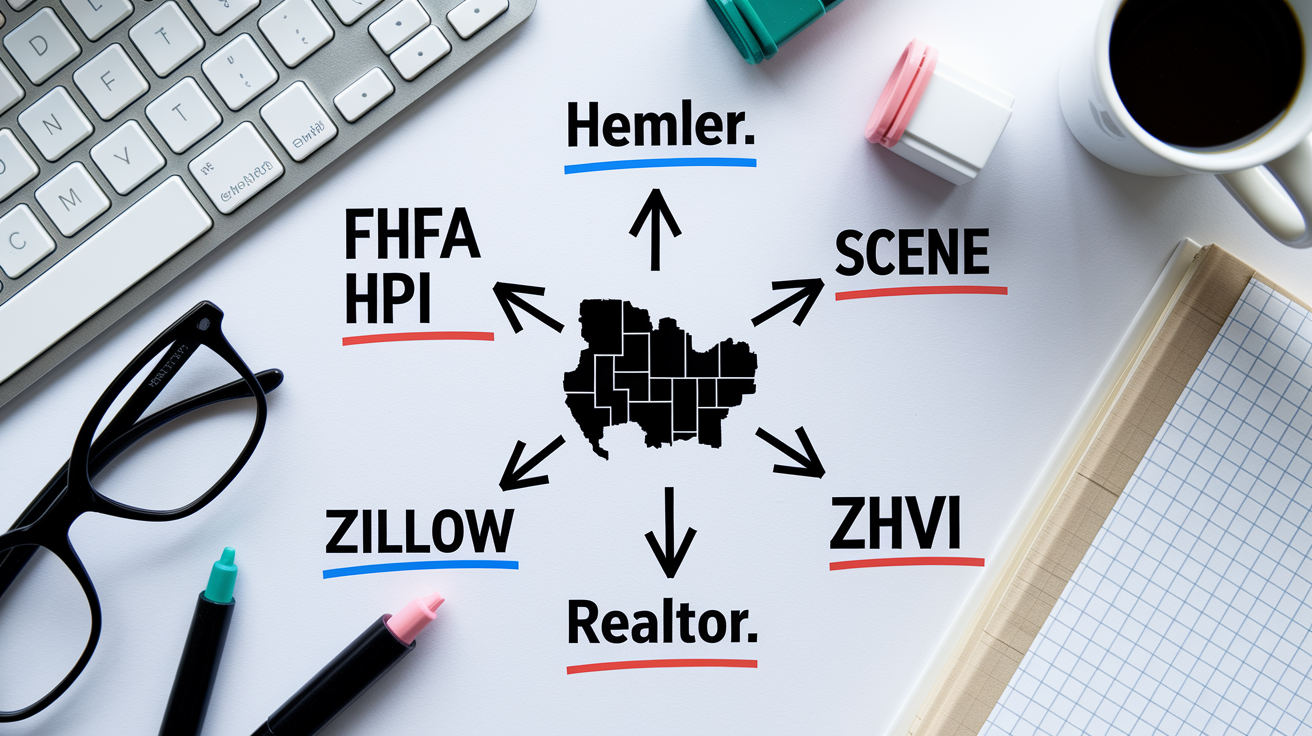
State-level price rankings lean heavily on the FHFA House Price Index, which uses repeat sales and refinancing data to track price changes for the same properties over time. That methodology controls for home quality and location shifts. When the same house sells twice, you’re measuring pure price movement. Metro-level analysis often blends FHFA HPI with Zillow’s median price estimates and Realtor.com median sale prices to capture both repeat-sale trends and current listing conditions. Time windows include year-over-year, quarter-to-quarter, and five-year comparisons. Each serves a different analytical purpose.
Different datasets have different strengths. FHFA covers the broadest geography and has the longest reliable history, but it lags by a quarter. Case-Shiller offers deep metro detail and rigorous methodology, but state-level aggregation is limited. Zillow and Realtor.com publish faster, near-real-time estimates. But median prices can swing with listing mix. If more expensive homes list one month, the median jumps even if individual home values stay flat. For state comparisons, FHFA is the anchor. For metro snapshots and faster signals, Zillow and Realtor.com fill the gaps.
| Dataset | Strength | Limitation |
|---|---|---|
| FHFA HPI | Repeat-sale methodology controls for home quality; broad geographic coverage | Quarterly lag; limited to conforming-loan universe |
| Case-Shiller | Rigorous repeat-sale index; deep metro detail | Limited state-level aggregation; slower publication |
| Zillow ZHVI | Near-real-time updates; covers most metros and ZIP codes | Estimated values can diverge from closed-sale prices |
| Realtor.com Median | Fast monthly updates; reflects active listings | Median swings with listing mix; not a same-home comparison |
Final Words
All 50 states plus DC posted positive year-over-year gains in Q1 2025, ranging 1.0% to 8.4%. Connecticut and Rhode Island led at 8.4%, New Jersey 7.8%, and the national pace was 4.7%.
Key drivers were job gains, migration from expensive metros, tight supply, and remote work widening demand. Higher mortgage rates cooled growth but didn’t reverse gains.
For a quick guide to states with fastest home price growth and why, watch jobs, inventory, and migration. These signals help buyers and sellers time moves, and they point to clearer market signals ahead.
FAQ
Q: Which state has the fastest growing real estate and where are home prices rising the fastest?
A: The fastest-growing real estate states are Connecticut and Rhode Island, each up 8.4% YoY in Q1 2025; New Jersey follows at 7.8%. National YoY pace was 4.7%, range 1.0%–8.4%.
Q: What is the 3-3-3 rule in real estate?
A: The 3-3-3 rule in real estate is an informal pricing guideline: if a home hasn’t sold in 3 months, consider a roughly 3% price cut and reassess at three-month intervals.
Q: What salary to afford a $1,000,000 house?
A: To afford a $1,000,000 house, aim for roughly $220,000–$270,000 gross income assuming 20% down, a 30-year mortgage near 6.75%, and typical taxes and insurance.