


Could one number save you hours of deal work?
The price-to-rent ratio does just that: price divided by annual rent gives a quick affordability signal.
In this post we’ll show how investors use that signal to screen metros, convert rents into justified prices, compare listings, and pick timing windows.
You’ll get practical rules of thumb for when a market favors renters or buyers, fast math shortcuts for go/no-go offers, and the trend checks that matter for cash flow-focused decisions.
How Investors Use the Price-to-Rent Ratio to Make Immediate Investment Decisions

The price-to-rent ratio divides a property’s sale price by the total annual rent it could generate. You get a clean number that tells you whether a market tilts toward ownership or rental demand. The formula is Average Property Price ÷ Average Annual Rent. If a home sells for $200,000 and comparable units rent for $1,250 per month, you annualize the rent ($1,250 × 12 = $15,000) and divide: $200,000 ÷ $15,000 = 13.3. That 13.3 becomes your signal.
Most investors sort markets into three buckets. A ratio of 15 or below suggests buying is cheaper than renting. Between 16 and 20 indicates a balanced market where renting edges ahead in many cases. And 21 or higher means renting is significantly cheaper than buying, which typically translates to robust tenant demand.
Real-world numbers land all over that spectrum. In Los Angeles during 2018, the average property price sat at $969,000 while average monthly rent was $2,140. Annualize that rent (that’s $2,140 × 12 = $25,680) and divide the price: $969,000 ÷ $25,680 ≈ 38. That high ratio told investors the city was firmly a renter’s market in terms of affordability. Strong rental demand, but expensive acquisition costs. Similar pattern showed up in the broader dataset: San Jose clocked a ratio of 42.16, San Francisco hit 37.34, even markets like Austin and Portland hovered in the high twenties. Each of those numbers signaled that tenants dominated the affordability equation, making rental inventory a stable play if you could stomach the entry price.
The national benchmark tells a longer story. In 2017 the average ratio across the country was 17.18, meaning renting and buying were nearly balanced. By 2021 that figure had climbed to 20.67. Recent snapshots have pushed it above 21.70. Over just four years prices rose faster than rents, widening the gap and tipping more metros into rent-favored territory. For investors that trend matters because it reflects rising acquisition costs alongside steady but slower rent growth. Which compresses yield and requires you to lean harder on appreciation or financing to hit return targets.
Standard thresholds matter, but the real value is how you deploy them. A ratio below 15 usually signals a market where ownership is cheap relative to rent. Often means softer tenant demand or a flood of owner-occupants squeezing out rental inventory opportunities. Ratios between 16 and 20 mark the sweet spot for many buy-to-rent strategies: prices haven’t run away from rent potential, and the population is split between owners and renters, creating reliable tenant flow. Above 21 you’re in high-demand rental territory where most residents can’t afford to buy, so vacancy risk drops and tenant pools deepen. Though your acquisition cost and financing load climb in tandem.
Investors use these ranges to drive fast go-no-go calls. If you’re screening fifty zip codes for a portfolio buy, pulling the price-to-rent ratio lets you eliminate low-ratio markets where rental demand is weak and flag high-ratio zones where tenant searches will be easier. The ratio also helps you time entry: a market with a rising ratio over consecutive quarters tells you prices are outpacing rents, which can squeeze cash flow if you buy at the peak. A falling ratio suggests prices are cooling faster than rents, opening a window to lock in better yield. None of this replaces full underwriting, but it narrows your shortlist before you spend time modeling expenses, financing, and exit scenarios.
Price-to-Rent Ratio Benchmarks and What They Reveal About Market Attractiveness

Take San Diego as a concrete case: median home value was $778,550, median monthly rent was $2,364, producing annual rent of $28,368. Divide price by annual rent and you get $778,550 ÷ $28,368 = 27.44. That number sits well above the 21 threshold, signaling that renting is far cheaper than buying for most residents. For an investor that high ratio means tenant demand is structurally strong because fewer people can afford to purchase. But it also means you’re paying a premium to acquire the property, which can pinch cap rates and cash-on-cash returns unless rents keep climbing or you use favorable financing. The ratio alone doesn’t tell you whether to buy. It tells you the competitive landscape between ownership and rental occupancy.
City-level snapshots sharpen the picture. San Jose’s ratio of 42.16 and San Francisco’s 37.34 sit at the extreme high end, reflecting metros where tech wages drive prices but where even high earners often rent due to down-payment hurdles and lifestyle preferences. Long Beach, Seattle, Oakland, Los Angeles, Austin, Portland, and Bakersfield all cluster between 26 and 33. That marks them as rental-dominant markets with varying acquisition costs. The common thread is that all these cities favor rental strategies over fix-and-flip or quick-turn plays, because the tenant base is large and persistent.
On the flip side, markets with ratios in the low teens or single digits (often found in secondary or tertiary metros and rural counties) tend to have weaker rental demand because buying is cheap enough that most households with stable income choose ownership.
Understanding what each band reveals:
Low benchmarks (≤15): Ownership is affordable relative to rent. Large share of residents buy rather than rent. Rental inventory can face higher vacancy or turnover. Often better suited to resale-focused strategies or very short-term rental plays in high-tourism zones.
Mid-range benchmarks (16–20): Balanced market where renting and buying are close in cost. Steady tenant demand with moderate acquisition prices. Ideal for beginner buy-to-rent investors seeking cash flow without extreme financing or appreciation bets.
High benchmarks (≥21): Renting is much cheaper than buying. Large, stable tenant pools. Lower vacancy risk. Higher acquisition cost and financing sensitivity. Best for long-term rental holds where appreciation and rent escalation fund returns over time.
Practical Price-to-Rent Ratio Applications for Real Estate Investment Decisions
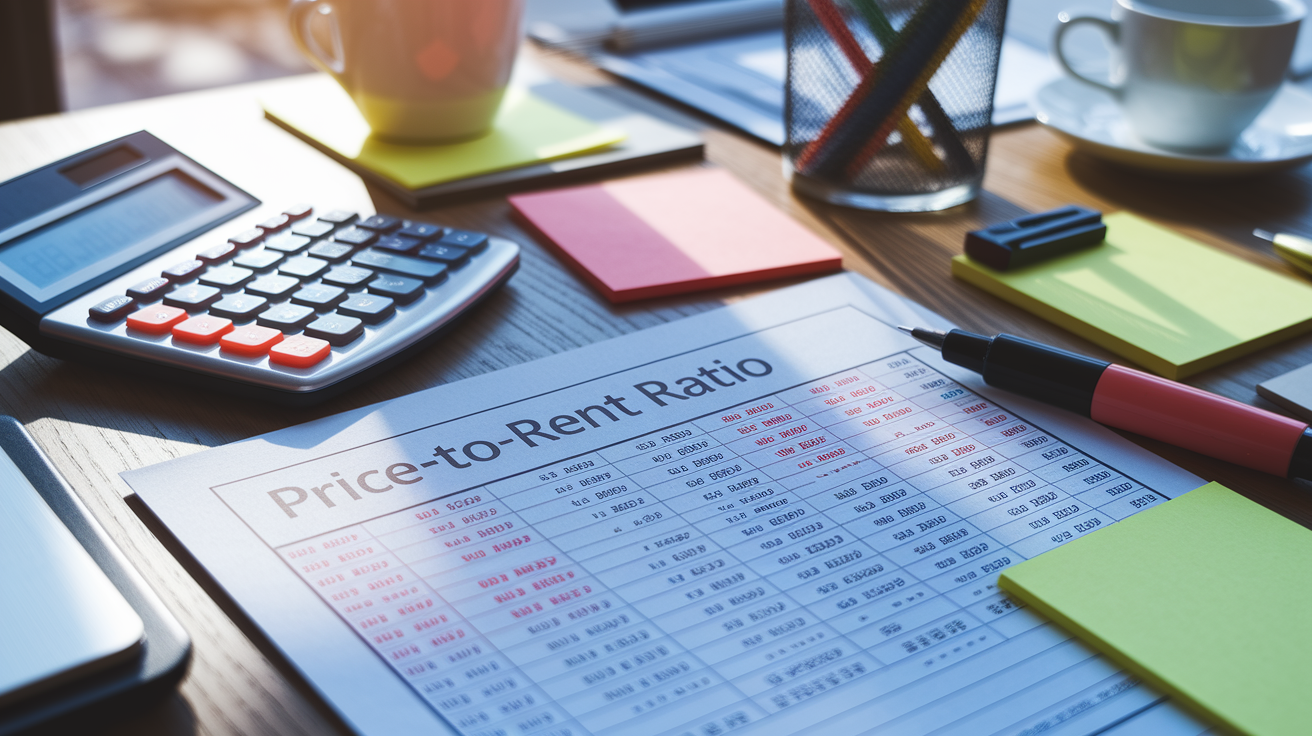
The ratio’s primary use is rapid market screening. When you’re comparing dozens of metros or neighborhoods, pulling median price and median rent data lets you calculate a ratio in seconds and immediately flag where rental demand is structurally sound. A high ratio tells you tenants dominate the market. A low ratio suggests most people buy. That insight doesn’t close a deal, but it steers your pipeline toward areas where tenant supply is reliable and away from markets where you’ll compete with owner-occupant buyers and face thinner renter pools. You can run the same screen at the zip-code or census-tract level to find pockets within a city that tilt more heavily toward rentals, even if the metro average looks balanced.
Property comparison becomes clearer when you standardize by ratio. Imagine two listings in the same neighborhood: one priced at $200,000, the other at $250,000. If the local ratio is 20, the implied annual rent for the first property is $200,000 ÷ 20 = $10,000, or about $833 per month. The second property implies $250,000 ÷ 20 = $12,500 annually, or roughly $1,042 per month. You can then check actual rent comps to see whether those implied rents are realistic. If the $200,000 property can command $1,100 per month (well above the implied $833), you’ve potentially found underpriced inventory. If the $250,000 unit struggles to hit $900, the acquisition price is too high relative to the market’s rent ceiling. This reverse-engineering shortcut speeds up deal triage before you order inspections or run full pro formas.
Investors also use the ratio to set acquisition targets and entry timing. If you know the going ratio in a market is 18 and you want to collect $1,500 per month in rent, you can estimate the maximum price you should pay: $1,500 × 12 = $18,000 annual rent. $18,000 × 18 = $324,000. Offers above that figure push you into a worse yield unless rents rise or the ratio compresses.
Tracking the ratio over quarters reveals cycles. A steadily rising ratio means prices are climbing faster than rents, which can signal late-cycle heat and thinner margins for new buyers. A falling ratio suggests prices are softening or rents are catching up, often creating entry opportunities as affordability improves and seller competition increases.
The four core applications in order:
Market selection: Screen large lists of counties or zip codes by ratio to identify rental-demand clusters. Prioritize ratios ≥16 for buy-to-rent strategies and flag ratios ≥21 for strongest tenant pools.
Property comparison: Convert listing prices into implied rents (price ÷ ratio) or convert target rents into maximum price (annual rent × ratio) to quickly spot outliers and mispriced deals.
Implied rent and value shortcuts: Use the formula both ways. Given price and ratio, solve for rent. Given rent and ratio, solve for justified market value. Create go-no-go thresholds before detailed underwriting.
Timing signals: Monitor ratio trends over time. Rising ratios warn of price-rent divergence and potential yield compression. Falling ratios highlight affordability improvements and better entry windows for financed buyers.
Numerical Examples Showing How Price-to-Rent Ratio Guides Investment Choices

Concrete math makes the concept stick. Example A starts with a property priced at $300,000 in a market where the prevailing ratio is 20. Divide price by ratio to find implied annual rent: $300,000 ÷ 20 = $15,000. Convert that to monthly: $15,000 ÷ 12 ≈ $1,250. If comps in the neighborhood confirm rents between $1,200 and $1,300, the property is priced in line with the market.
But if you can push rent to $1,400 through light upgrades (new paint, appliances, flooring), you’re generating $16,800 annually. Which improves your effective ratio to $300,000 ÷ $16,800 ≈ 17.86, a better yield than the market average and a signal that the deal has upside.
Example B compares two markets to show how ratio differences translate to strategy. Market One has a ratio of 25, meaning for every dollar of annual rent you need to invest $25 in purchase price. Market Two sits at 12, so each dollar of rent costs only $12 to acquire. On the surface Market Two looks cheaper and more efficient. But that low ratio often reflects weak rental demand because buying is so affordable that most residents purchase rather than rent. Market One’s high ratio signals strong tenant demand and a large renter population, which reduces vacancy risk and tenant turnover. An investor focused on stable, long-term cash flow typically prefers the 25 market despite higher acquisition cost. A fix-and-flip operator might target the 12 market to capture buyer demand quickly.
Example C layers in financing to show interaction with mortgage payments and operating expenses. Assume the same $300,000 property with a ratio of 20 and implied annual rent of $15,000. You put down 20 percent ($60,000) and finance $240,000 at 7 percent over 30 years, producing a monthly mortgage payment of roughly $1,597. Add estimated annual operating expenses of $3,600 for taxes, insurance, maintenance, and vacancy reserve (about $300 per month). Total monthly outlay is $1,597 + $300 = $1,897. Your gross monthly rent is $1,250, leaving a negative cash flow of $647 per month.
The ratio told you acquisition price was in line with market rent, but it didn’t account for financing cost or expenses. Which is why cap rate and cash-on-cash return are necessary next steps. If you reduce financing (say, 40 percent down), the mortgage drops to $1,197 per month, trimming the shortfall and making the deal break-even or slightly positive depending on actual vacancy and repair costs.
| Scenario | Inputs Used | Output (PTR / Rent / Value) |
|---|---|---|
| Example A | Price $300,000; Ratio 20 | Annual rent $15,000; Monthly rent $1,250 |
| Example B | Market One ratio 25; Market Two ratio 12 | Market One: higher tenant demand, lower vacancy; Market Two: weaker rental demand, flip-friendly |
| Example C | Price $300,000; 20% down; 7% rate; $3,600 annual opex | Gross rent $1,250/mo; Mortgage + opex $1,897/mo; Negative cash flow $647/mo |
How Price-to-Rent Ratio Fits With Cap Rate, Cash-on-Cash Return, and NOI

Cap rate measures yield by dividing net operating income by purchase price: Cap Rate = NOI ÷ Property Price. NOI is annual rental income minus all operating expenses (taxes, insurance, management fees, maintenance, vacancy allowance), but before mortgage payments. A property generating $18,000 in gross rent with $6,000 in operating expenses produces $12,000 NOI. If the purchase price is $240,000, the cap rate is $12,000 ÷ $240,000 = 5 percent.
Cap rate reflects true operating performance and lets you compare properties on an apples-to-apples basis regardless of how they’re financed. Price-to-rent ratio skips the expense step entirely and uses gross rent, so it can’t tell you actual yield. Only the rough relationship between acquisition cost and rent potential.
Cash-on-cash return narrows the lens further by dividing NOI by the total cash you invested (down payment, closing costs, and any rehab or capital improvements). Using the same $12,000 NOI example, if you put $50,000 into the deal (down payment plus closing), your cash-on-cash return is $12,000 ÷ $50,000 = 24 percent. That metric matters most to financed investors because it shows how efficiently your own money is working, separate from the lender’s capital. Price-to-rent ratio ignores financing completely, so two identical properties with the same ratio can deliver vastly different cash-on-cash returns depending on loan-to-value, interest rate, and the amount of cash you deploy up front.
The gross rent multiplier (GRM) is the property-specific cousin of the price-to-rent ratio. GRM divides a single property’s price by its annual gross rent: if a duplex costs $180,000 and collects $18,000 per year, the GRM is 10. Lower GRM means you’re paying less per dollar of rent, similar to a lower price-to-rent ratio. The difference is that GRM applies to individual deals while price-to-rent ratio is typically calculated at the market level using median or average figures. Both metrics ignore expenses and financing, making them useful for quick screening but insufficient for final investment decisions.
Key differences among the four metrics:
Price-to-Rent Ratio: Market-level affordability signal. Uses gross rent. Ignores expenses and financing. Best for initial market screening and comparing metros or neighborhoods.
Cap Rate: Property-level yield measure. Uses NOI (rent minus expenses). Ignores financing. Compares operating performance across deals and asset classes.
Cash-on-Cash Return: Investor-level efficiency measure. Uses NOI and total cash invested. Accounts for financing. Shows actual return on your deployed capital.
Gross Rent Multiplier (GRM): Property-level quick screen. Uses gross rent. Ignores expenses and financing. Similar to price-to-rent ratio but applied to individual listings rather than market averages.
Limitations, Regional Variations, and When the Price-to-Rent Ratio Misleads Investors

The ratio treats rent and price as static, but mortgage interest rates shift those numbers dramatically. A 3 percent thirty-year rate versus a 7 percent rate can double monthly principal and interest payments on the same loan balance, flipping a market from buy-favored to rent-favored without any change in price or rent. The ratio also omits all ownership costs (property taxes, insurance, HOA fees, maintenance reserves, capital expenditures) and all tenant-side costs like utilities and renter’s insurance. Two markets with identical ratios can deliver vastly different net cash flow if one has twice the property-tax rate or requires flood insurance.
Seasonal rent swings add another wrinkle. Spring and summer rents often spike in college towns and tourist markets, inflating the annualized figure if you calculate during peak months. Winter comps can understate true rent potential.
Regional and temporal variations can mislead if you rely on national benchmarks. Coastal metros and tech hubs routinely post ratios above 30, while Rust Belt cities and rural counties often sit in the single digits or low teens. A ratio of 25 might signal overheated speculation in one market and stable, mature rental demand in another, depending on wage growth, population trends, and housing supply. The national average ratio climbed from 17.18 in 2017 to 20.67 in 2021, a swing of nearly 20 percent in four years. Driven by pandemic-era price surges and lagging rent growth in some segments. That kind of movement during a market cycle means a threshold that worked in 2019 may undershoot or overshoot opportunity in 2023 or beyond. Always compare current local ratios to their own historical range rather than assuming a universal number applies everywhere.
Property condition, vacancy assumptions, and rent-control regulations don’t show up in the ratio but can destroy a deal. A property priced at market with an attractive ratio might need $30,000 in deferred maintenance before it’s rentable. Or it might sit in a jurisdiction with annual rent-increase caps that lock you into below-market cash flow for years. Vacancy is especially important: the ratio assumes full occupancy, but real-world portfolios run 5 to 10 percent vacancy on average, sometimes higher in transitional neighborhoods or during tenant turnover. If your implied rent is $1,500 per month but you’re vacant two months per year, your effective annual rent drops to $15,000 instead of $18,000, pushing your real ratio higher and your yield lower. None of these factors disqualify the price-to-rent ratio as a tool. They just confirm it’s a first filter, not a final answer.
A Step-by-Step Workflow for Using Price-to-Rent Ratio in Investment Decisions

Start by pulling price-to-rent ratios for every zip code or neighborhood on your target list, using the most recent median home-value and median-rent data you can find. Rank the list and eliminate any market with a ratio below 16 if your strategy is buy-to-rent, since low ratios typically signal weak tenant demand or ownership-heavy populations. Flag markets with ratios between 16 and 25 as your core screening pool, and separately note any above 25 as high-demand rental zones that may require more financing or longer hold periods to pencil. This first pass should take minutes and cut your pipeline by half or more, letting you focus research time on the markets that structurally favor rentals.
Screen markets by price-to-rent ratio thresholds: Pull median price and rent data. Calculate ratios. Eliminate low-ratio markets (≤15) unless pursuing fix-and-flip. Prioritize mid-to-high ratios (16–25+) for rental strategies.
Run property-level cap rate, NOI, and cash-on-cash estimates: For each shortlisted property, estimate annual gross rent from comps. Subtract realistic operating expenses (taxes, insurance, management, maintenance, vacancy allowance) to get NOI. Then divide NOI by asking price for cap rate and by total cash invested (down payment + closing + rehab) for cash-on-cash return.
Adjust rents using hyper-local comps and occupancy data: Verify that your rent assumption matches actual signed leases in the immediate neighborhood for comparable units. Adjust for condition, amenities, and lease terms. Apply a vacancy factor (typically 5–10 percent) to convert gross potential rent into effective gross income.
Factor in local vacancy rates, property taxes, insurance, and regulatory costs: Check city or county tax assessments and insurance quotes. Research rent-control ordinances, tenant-protection laws, and eviction timelines. Include these in your operating-expense projection to avoid underestimating outflows.
Model multiple financing scenarios and sensitivity tests: Run the numbers with 20 percent down, 25 percent down, and all-cash. Test interest rates 0.5 and 1.0 points above and below your base case. Calculate break-even occupancy and the cash-flow cushion at each financing level.
Evaluate exit strategy and long-term appreciation assumptions: Determine whether you plan to hold for cash flow, refinance and pull equity, or sell after appreciation. Stress-test your return assumptions against declining rents, rising rates, or extended vacancy. Confirm the deal still meets your minimum hurdle rate in a downside scenario before making an offer.
Final Words
Use the price-to-rent ratio as a fast filter to find where buying or renting makes more sense right now.
We covered the formula, common thresholds, city benchmarks, practical applications, numeric examples, how PTR sits beside cap rate and cash returns, the limits, and a repeatable workflow.
If you invest, add PTR to your screening process, but pair it with local rents, vacancy, and financing scenarios. Small changes in those inputs can flip a decision, and that makes the price-to-rent ratio uses for investment decisions a practical edge to act on.
FAQ
Q: What is a good rent to price ratio for investors?
A: A good rent-to-price ratio is price ÷ annual rent at about 15 or lower for buy-to-rent appeal; 16–20 is balanced, and 21+ usually means renting is cheaper than buying in that market.
Q: What is the 2% rule for rentals?
A: The 2% rule says monthly rent should equal at least 2% of the purchase price to help cover expenses and cash flow; it’s rare in expensive metros and more realistic in lower-cost markets.
Q: What is the 30 50 20 rule for rent?
A: The 30/50/20 rule for rent says keep rent near 30% of gross income, as part of a budget where 50% covers essentials and 20% goes to savings or debt repayment.
Q: What is the 7% rule in real estate?
A: The 7% rule in real estate is a rough guideline that allocates about 7% of gross rent (or sometimes property value) for annual maintenance, vacancy, and small repairs; use detailed budgets instead.